Posts

baby attacks chocolate easter egg, canadian actress hired as swimmer

Image
Source: Daily Mirror (overseas edition), April 4, 1953. One of the oddest Easter images found kicking around the ol' Warehouse. If the egg was smaller, it would be tempting to label this post "Giant Mutant Baby Altered by Nuclear Test Attacks Innocent Easter Egg." As it is, it's as goofy as a shot in the same browning bound edition of the British tabloid featuring Orson Welles wolfing down a bowl of spaghetti . Perhaps the Mirror should have sponsored an eating contest between this chocolate-loving child and the movie auteur.
past pieces of toronto: the temple building

Image
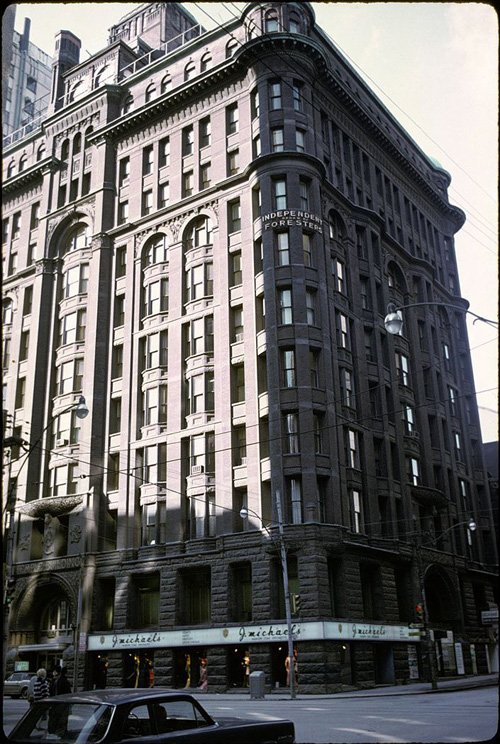
From November 2011 through July 2012 I wrote the "Past Pieces of Toronto" column for OpenFile, which explored elements of the city which no longer exist. The following was originally posted on March 11, 2012. Temple Building, probably between 1967 and 1970.  Photo by Ellis Wiley. City of Toronto Archives, Fonds 124, File 2, Item 53. One of the sections marked "Temple Building" above the entrances survives as a ruin at The Guild. “Want to go see a monument destroyed?” the Globe and Mail asked readers in its July 6, 1970 editorial. “Go down to the corner of Bay and Richmond streets and watch them make gravel out of the Temple Building . It won’t go easily or prettily because it wasn’t built with destruction in mind. It was intended to last like the Pyramids, one of the wonders of a young country, a great stone tribute to an Iroquois who became supreme chief ranger of the Independent Order of Foresters (IOF) in 1881.” Oronhyatekha liked whatever he ...

sound tracks: a sampling of detroit record stores, circa 1990

Image
When I hit my teens, I started imitating my father’s interest in building a healthy music library. It started with an occasional cassette, then the gift of The Beatles 1962-1966 (aka “The Red Album”). During a stop at Sam the Record Man on a grade eight trip to Toronto—a stop I insisted the group I was with make, even if it cut into others’ precious time at Yonge Street head shops—I bought my first large haul of pre-recorded music, some of which is now laughable but was influenced by peers at the time—Poison’s Open Up and Say...Ahh!  anyone? In early 1990, my father clipped an article from the Detroit News listing record stores worth investigating on future cross-border trips. Both of us, along with my sister, would rapidly expand our collections thanks to at least two stores listed in the piece. Twenty-three years on, most things associated with this article are gone. Nearly all the stores profiled. The massive tape collection I built up. My father. Yet, along wit...

past pieces of toronto: the four seasons motor hotel

Image
From November 2011 through July 2012 I wrote the "Past Pieces of Toronto" column for OpenFile, which explored elements of the city which no longer exist. The following was originally posted on March 24, 2012, with some additions made on March 7, 2013. When Isadore “Issy” Sharp decided to build his first Four Seasons hotel at Jarvis and Carlton Streets, everyone thought he had lost his mind. Once a street lined with the homes of wealthy Torontonians, by the end of the 1950s it had a reputation as a hangout for derelicts, drug dealers and prostitutes. “How could you think of building a motel or hotel on Jarvis?” he was told. “People will think it’s a flophouse!” Sharp ignored those comments. Once opened, nobody mistook the hotel at 415 Jarvis Street for a flophouse. As the Globe and Mail noted years later, the Four Seasons Motel Hotel was “an elegant, relaxed place for a drink or a night’s stay.” Sharp, who worked at his father’s construction firm, had gathere...

past pieces of toronto: subway interlining

Image
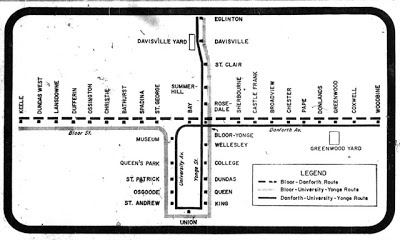
From November 2011 through July 2012 I wrote the "Past Pieces of Toronto" column for OpenFile, which explored elements of the city which no longer exist. The following was originally posted on May 13, 2012. Map showing subway interlining. The Telegram , February 25, 1966. When you mention lower Bay station, images conjured include an abandoned subway platform used for film shoots, a TTC test lab, a Nuit Blanche installation venue or an occasional construction detour . But when the Bloor-Danforth line opened in February 1966, lower Bay was part of an experiment to allow riders to reach any destination without transferring lines. The wye , a triangular-shaped rail intersection that allowed interlining, proved highly contentious among TTC officials during its six months of regular service use. The wye was among subway designer Norman Wilson’s recommendations when the Bloor-Danforth subway line was proposed in 1958. “The importance of this [wye] connection bet...

past pieces of toronto: the telegram building

Image
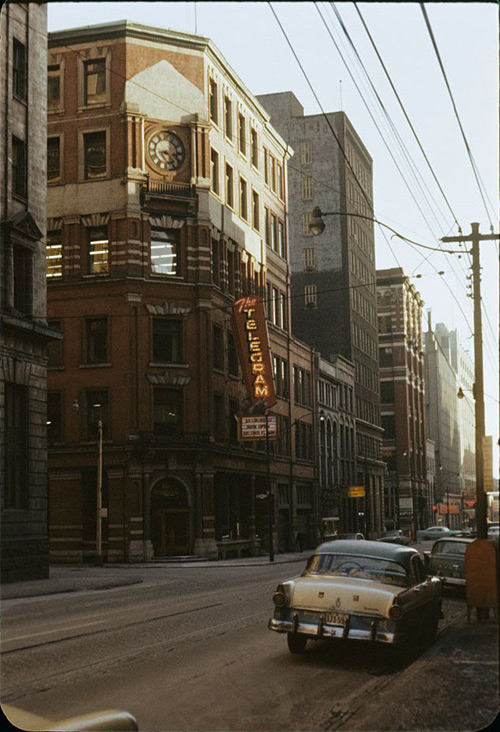
From November 2011 through July 2012 I wrote the "Past Pieces of Toronto" column for OpenFile, which explored elements of the city which no longer exist. The following was originally posted on February 12, 2012. Photo of the Telegram Building by Ellis Wiley, taken prior to 1966, City of Toronto Archives Fonds 124, File 1, Item 91. British press baron Lord Northcliffe referred to it as “the finest newspaper office I have ever visited.” Most people called it “the old lady of Melinda Street.” For over 60 years, the rambling collection of buildings at the southeast corner of Bay and Melinda Streets was home to the Telegram , the voice of the city’s conservative Protestant working class. By the late 1890s, the Telegram had outgrown its offices at King and Bay. While warned about staying on Bay Street, whose homes and businesses were regarded as being in seedy decline, publisher John Ross Robertson was drawn to the Crown Hotel a block south at Melinda Street. A...

stand up and tell 'em you're from detroit

Image
Alas poor Detroit. A city teetering on the brink of receiving an emergency financial manager appointed by the state of Michigan run its affairs .A city that has become a poster child for ruin porn. A city Forbes magazine declared to be " America’s Most Miserable City ." Yep, Motown is going through a rough patch. How, when, or if it bounces back remains to be seen.

past pieces of toronto: spadina's moving walkways

Image
From November 2011 through July 2012 I wrote the "Past Pieces of Toronto" column for OpenFile, which explored elements of the city which no longer exist. The following was originally posted on February 5, 2012. Spadina moving walkway. Photo by Eva Amsen . With eyes closed, imagine yourself at an airport ready to embark on a jet-age journey to an exotic destination. As you and your backpack, briefcase, or luggage glide along the moving walkway, dreams of adventure or relaxation fill your head. The faint odour of rodents barely distracts you from your visions. Suddenly, there’s a lurch at the end of the walkway that jolts you back into the reality of standing at either end of the Spadina subway station. We may be exaggerating the experience one could have had using the moving walkways that carried TTC passengers between subway lines for 25 years. Whether you saw the moving walkway as a novelty item, a useful connector or, as a cranky early user told the Star,...

bonus features: william peyton hubbard

Image
This post offers supplementary material for a recent "Ghost City" column in The Grid , which you should read first before diving into the following text. Among the neat things I found while looking through the city archive files on William Peyton Hubbard was a letter from 1907 stamped with Toronto's official civic seal. The document was an official notice from Mayor Emerson Coatsworth vouching for Hubbard while the latter toured Washington and other American cities. Given the racial attitudes of the time, I suspect there were numerous occasions this letter aided Hubbard. Mr. Hubbard is a highly esteemed citizen of Toronto. He is now and has been for many years a leading member of our City Council, during which time he has occupied a number of positions of prominence. He has been repeatedly elected to the Board of Control by the City at large, and has occupied the position of Vice-Chairman of the Board, a position second only in importance to that of Mayor...

love and shortening

Image
Source: the Globe , December 20, 1893. To those celebrating Valentine's Day later this week, keep this in mind: a relationship can't be cemented unless there's high-quality shortening uniting you. According to Wikipedia , Cottolene was a beef tallow and cottonseed oil based shortening marketed from 1868 through the mid-20th century. Its advertising campaigns were directed at destroying North America's "lard habit." Please don't let this catch the eye of some Crisco executive, lest they get the brilliant idea to run a viral marketing campaign based around romance and their product. There are many, many roads that could go down, some of which aren't safe for work.

bonus features: when mel freezes over...

Image
This post provides supplementary material for an article in The Grid regarding the time the army was called in to help Toronto cope with a major snowstorm in 1999 , which you should read before diving into the following text. Front page, Toronto Sun , January 15, 1999. Confession time: I’m drawing a blank as to what I did during the Snowmageddon of January 1999. I definitely experienced it—at the time I was living in Guelph, working at the campus paper. Given the regular dumpings Guelph received, the storm likely didn’t seem unusual. It was probably just another snowy day, albeit one with greater accumulation. My guess is that either I curled up with a pile of library books or headed over to the Ontarion office to work, surf the net, or play endless games of Civilization II . It was around this time that staff relations within the office settled into a permanent deep-freeze, sparked by deep disagreements about the cover of that week’s issue. The only story about the st...

past pieces of toronto: palace pier

Image
From November 2011 through July 2012 I wrote the "Past Pieces of Toronto" column for OpenFile, which explored elements of the city which no longer exist. The following was originally posted on January 15, 2012. A scene from an evening at Palace Pier: during a dance sponsored by the Arthur Murray Dance Studio in January 1951, participants were officially greeted by Toronto Controller John Innes. As his speech neared its end, he noted that it would be nice if everyone in the hall knew how to do an old-fashioned waltz. “Having said his piece,” reported the Star ’s Alex Barris, “Controller Innes was leaving the stage when the band started playing—a waltz.” Innes grabbed Lisa Derny, an Arthur Murray employee who had introduced him to the audience earlier in the evening, “waltzed her around a couple of times, planted a kiss on her cheek and strutted off.” That anyone ever received a kiss at Palace Pier was a minor miracle given the venue’s checkered history. When...

the rustic charms of grandpa's wonder pine tar soap

Image
The things curiosity will lead you to do… About two years ago, my friend Sarah and I discovered a Detroit-based blog called Sweet Juniper . Among the great photoshoots of the author’s kids parading around Motown in homemade costumes (think Robocop as if it actually was filmed in Detroit ), there was a post with the intriguing title “ An Attempt to Explain Why I Smell Like George Brett’s Gym Bag .” Seems he has a friend who likes giving him unusual gifts—in this case, it was a bar of Grandpa’s Wonder Pine Tar Soap found in a garage. The packaging depicts a trustworthy old-timey white-bearded gentleman. Whether dispensing wisdom at a family gathering or helping the kids put on the show that will save the local library, Grandpa is undoubtedly a pillar of whatever community he produces his manly soap—in this case, suburban Cincinnati. He’s made his acne-and-psoriasis relief aid since 1878 , so it must have satisfied a few customers over the centuries.

past pieces of toronto: the odeon hyland

Image
From November 2011 through July 2012 I wrote the "Past Pieces of Toronto" column for OpenFile, which explored elements of the city which no longer exist. The following was originally posted on December 30, 2011.  Opening ad for the Odeon Hyland. The Toronto Star , November 17, 1948 It was a dicey proposition: testing out a brand new movie theatre, and the Shakespearian adaptation that was its opening attraction, by filling the first showing with high school students. It was especially dicey after rowdy teens had recently disrupted a recent festival honouring the Bard at the Eaton Auditorium (now the Carlu). But Odeon Theatres officials felt that filling the new Hyland theatre with students from Northern Vocational High School (now Northern Secondary) for the afternoon presentation of Sir Laurence Olivier’s version of Hamlet on November 22, 1948 was worth any potential mishaps. According to the Star, the kids were alright: The kids at the showing were well-beh...

at the coffee house

Image
Found this cartoon while researching this weekend's edition of Historicist . I can sympathize with the frustrated diner -- a couple of months ago a friend and I experienced a lengthy delay at a Corktown brunch spot we had liked. Over an hour passed before we discovered our order had slipped through the cracks. Usually the 100-year wait while dining in Toronto is for the bill. I usually dash to the cash when it's time to go, regardless of the grumbly looks this occasionally inspires. Source: the News , December 31, 1887.

bonus features: prudish about pinball

Image
This post provides supplementary material for a Torontoist article about the evolution of Toronto's pinball machine regulations , which you should read before diving into the following text. I began my research for the article by going back to the 1930s, when guardians of morality began pressing to curb or eliminate pinball machines. On my first run through the Star archives, one of the earliest references to pinball I found was on the kids page of the May 5, 1934 edition. Problem: it wasn’t the pinball I was looking for:

past pieces of toronto: the paradise cinema

Image
From November 2011 through July 2012 I wrote the "Past Pieces of Toronto" column for OpenFile, which explored elements of the city which no longer exist. The following was originally posted on January 29, 2012. At this point, the column went from biweekly to weekly. This entry also seems like a good one to repost now with news that the Paradise has been sold . Personal story: the first time I went to the Paradise was to see Robert Altman’s Nashville . The print was faded, but watchable; my seat was in rougher shape. The armrest was barely attached to the rest of the chair with either duct tape or chewing gum. While some people would have hightailed it to the nearest theatre with stadium seating, the improvised fix gave the Paradise a certain charm. Opened around 1937, and known for a time as the New Paradise, it was a neighbourhood cinema that served the community around Bloor Street West and Westmoreland Avenue. Notes in the City of Toronto Archives indicate ...

12/12/12 in 1912

Image
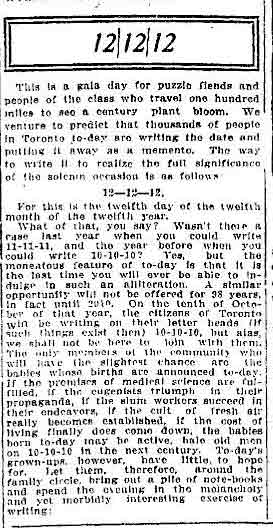
In honour of today being the 12 th day of the 12 th month of 2012, here’s a roundup of front-page headlines from a carefully selected batch (as in those I could get my hands earlier this morning) of Toronto newspapers the last time the calendar read 12/12/12: The Toronto Daily Star The only paper to acknowledge the significance of the date, which it called “a gala day for puzzle fiends and people of the class of who travel one hundred miles to see a century plant boom.” The Star also wins the best headline of the day: “THE KING AND YONGE CORNER HAS BECOME A GUSTY SPOT.” Recent gale-force winds added to the problems of crossing King and Yonge in the shadow of one of the city’s first skyscrapers, the Canadian Pacific Building . “Ladies making the crossing looked in some particulars like the pictures of fishermen’s daughters down on the stormy strand, when they have lost hope for their loved ones in the fishing boats out on the raging seas.” The wind tunnel effect ...

past pieces of toronto: maple leaf stadium

Image
From November 2011 through July 2012 I wrote the "Past Pieces of Toronto" column for OpenFile, which explored elements of the city which no longer exist. The following was originally posted on December 16, 2011. The paid attendance figure said it all: 802. A venue with a capacity of 18,000 that had once crammed as many as 4,000 more people than that into it was going out with a whimper. The sparse number of fans who witnessed the last baseball game at Maple Leaf Stadium on September 4, 1967 didn’t even have the satisfaction of seeing the hometown Maple Leafs achieve a final victory. A 7-2 loss marked the end of upper-level minor league ball in Toronto and 40 years of play at the foot of Bathurst Street. Ironically, the winning team, the Syracuse Chiefs, later became the farm club for Toronto’s long-awaited major league ball club. Yet Maple Leaf Stadium wasn’t far removed from its glory days. Under Jack Kent Cooke’s ownership during the 1950s , the Maple Leaf...

e.t. phoned home, then complained to the toronto sun

Image
As I once wrote in a Historicist column , it was hard to tell if longtime Toronto newspaper columnist McKenzie Porter believed everything he wrote or pulled the legs of innocent readers. His columns for the Telegram and the Toronto Sun are full of head-scratching passages that are hopefully meant to be satirical. Ranting about pooping is definitely humorous, defending apartheid in South Africa less so. The absurdity of Porter's columns fits comfortably with the contrarion streak that has always filled the Sun 's pages. While researching an upcoming article, I came across this beaut of a Porter column about the movie E.T. It’s one of the oddest attacks of the Steven Spielberg classic I’ve ever read. The film’s problem? It caters to idiots who project human qualities onto animals and other beings! Source: the Toronto Sun , August 6, 1982 Please, please tell me that last line about eugenics was a joke…