Posts

Showing posts with the label comic books

what's your b.q.? *brotherhood quotient

Image
Our Army at War #166, April 1966. This is a revamped and expanded version of a post I originally wrote in 2010.  Are you ready to compare your degrees of tolerance towards cabbages, foreigners and pulp fiction?  Given when this was published (early February 1966), I'd be curious to see how the like/dislike portion would have been filled in areas at the heart of the civil rights movement—what would a kid in New York City's response have been like compared to one from Alabama? This quiz to test your levels of prejudice was one of a long-running series of public service announcements from the National Social Welfare Assembly that were published in various DC comics between 1949 and 1967.  Action Comics #251, April 1959. This ad, which originally ran in 1959, was written by editor Jack Schiff (who championed fillers like this to prove comics could be a constructive influence on 1950s youth) and drawn by Bernard Baily (the original artist of  the Spectre , a hero ...
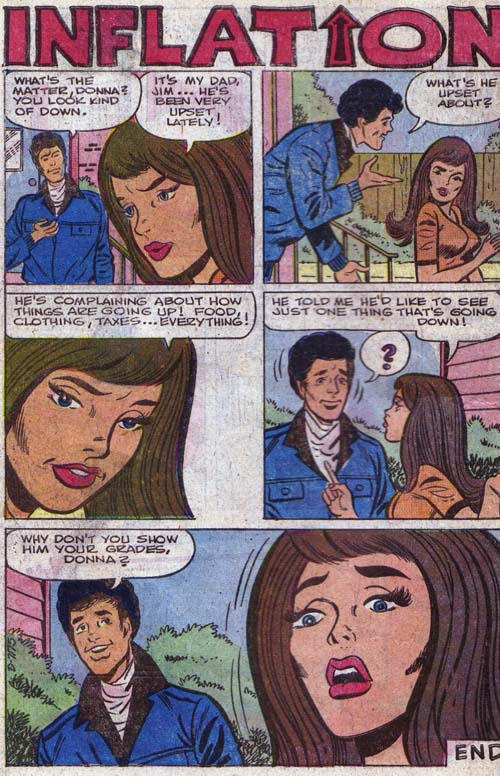
vintage awful romance comics of the day

Image
Just Married #107, September 1975 By the end of the 1950s, the majority of comic-book publishers were gone, victims of the great comic-industry slump, and by the 1960s only Charlton, Marvel, and DC Comics were still publishing romances. Of the three, Charlton's were probably the absolute worst love comics ever produced. Each issue gave the impression that, after having blown their entire monthly budget on a beautiful cover, the editors parceled out the interior pages to various talented high school relatives of the staff. - Trina Robbins, From Girls to Grrrlz (1999) While doing some file housekeeping on my computer, I found several scans of one-page fillers from those rock-bottom Charlton romance comics. In this particular issue, the uncredited writers (who online databases don't identify, possibly to spare them embarrassment) were fixated on how many punchlines they could write based on the low intelligence of females. Truly bottom-of-the-barrel stuff, relying on tire...

bonus features: memory lane

Image
This post offers supplementary material for an article I originally wrote for The Grid , and was recently republished by Torontoist , which you should read before diving into this piece.  Toronto Star , July 23, 1966. Click on image for larger version. Of the other stores mentioned in this article, Ryerson Press's home at 299 Queen West would become home to the CHUM/CITY media empire.

the new wonder woman is here!

Image
Star Weekly , September 15, 1968. By 1968, Wonder Woman was long overdue for a major revamp. Over the decades since her introduction in  1941, the edginess that marked her early years (especially the kinkiness slipped in by creator William Moulton Marston ) had been watered down. Her rogues gallery was nothing to write home about, from boring baddies like Angle Man to the bizarre, not-at-all-racist Egg Fu . An attempt to revive the character's 1940s look had faltered. Her dowdy alter-ego, military secretary Diana Prince, just wouldn't do in a Vietnam world. Cue makeover. Writer Denny O'Neil and artist Mike Sekowsky shook up Wonder Woman's world with a series of changes that transformed her from a star-spangled heroine into an Emma Peel-inspired protagonist: Dumped the costume in favour of mod clothing, which evolved into various white-coloured outfits by the early 1970s Killed off useless love interest Steve Trevor, replacing him with a blind Asian mentor n...

romance comic department

Image
In the midst of winter cleaning at the Warehouse, we've uncovered a treasure trove of romance comics from the 1960s and 1970s. Here's one of the gems we found. After a near-death experience with a perfectly spherical boulder that charged at you on an idyllic cliffside beach, what pair of stiffly-drawn young lovers can't resist a touch of in-law humour? John and his unnamed lover soon returned to the picnic, where everyone had a good laugh as if it was the closing minute of a Hanna-Barbera cartoon. When the lovebirds wandered off to change their clothes, the in-laws had a quiet conversation... MOTHER : I told you not to buy a boulder from the Acme catalogue! FATHER : But it was the only one I could afford! SMERSH's boulders cost too much! MOTHER : (sighs) I knew I should have brought the arsenic. None of the major comic book databases have a clue as to who the uncredited writer and artist of this one-page filler were. Source: Just Married #102 , October 19...

an important, almost forgotten, revelation about the joker

Image
The root cause of the Joker's insanity? Not a chemical bubble bath. Not an incredibly rotten day. Nope. He doesn't like Hostess Fruit Pies! After all, who in their right mind can resist the allure of tender crust and fruit filling full of chemical additives and globular bits that once resembled real fruit? The Clown Prince of Crime's mistake was forgetting that since there were no donut shops in this particular precinct, the cops fulfilled their daily sugar and lard dietary requirement by purchasing fruit pies at the Kwik-E-Mart two blocks from the station. Source: Justice League of America #142, May 1977 - JB

vintage mad house ad of the day

Image
Given Snoopy's attempts at submitting stories to publishers (usually involving a horrible pun or cliched phrase ), it seems appropriate that everyone's favourite beagle would be the Peanuts character chosen to grace a motorized pencil sharpener. If Snoopy can't sharpen your pencil, he will offer you a cookie as compensation...at least he will if you visit the Charles M. Schulz Museum in Santa Rosa, California. *** Mad House began in the late 1950s as Archie's Mad House , featuring the usual hijinks from Riverdale. Over the years the series underwent numerous format and title changes, with the constant being the house-style art. After a period chronicling the adventures of the stylish rock band Mad House Glads , the series became a full-fledged horror title and was labelled as part of the short-lived 70s incarnation of Red Circle Comics . Under an alluring Gray Morrow cover are four tales, of which the first two are: * Never Bother a Dead Man (story: Mar...

teen talk, 1960s style

Image
This slice of "teen humour" was a space filler in a 1960s issue of Teen Titans that was so decayed that it accompanied a week's worth of the Globe and Mail and half-a-dozen cereal boxes to the recycling bin instead of finding its way to a Goodwill or comic book shop. Probably the most interesting element is the artist: Mort Drucker , whose work for National/DC was usually found in its war titles. At this point, he was also a decade into his run as one of the key artists for Mad , where he gradually became the chief artist for the magazine's movie and TV satires. As for the comic itself, Siskoid's Blog of Geekery tells you all to need to know ...or maybe all you really know is that the villain Robin, Wonder Girl, Kid Flash and Aqualad took on was a robot named Honey Bun. Honey Bun . Source: Teen Titans #8 , March-April 1967 - JB

vintage marvel super-heroes ad of the day

Image
Source: Marvel Super-Heroes #34, January 1973. No geeky newsboys for Grit as the 1972 holiday season neared, just a parade of prizes in green and red. Perhaps the paper hoped the colour scheme would appeal down-on-their-luck or tight-allowanced readers desperate for money or economic gifts to give at Christmas? But wait, isn't this comic book dated January? Wouldn't the holiday season have been winding down to a close or over by the time this issue hit the stands? Nope. Since comic books were dated two to three months after they hit the newsstands, the January 1973 Marvel lineup would have hit newsstands closer to Halloween than Christmas. Wikipedia provides a brief explanation . *** Originally published in Tales to Astonish #79 (May 1966), The Titan and the Torment! (story: Stan Lee, art: Bill Everett over Jack Kirby layouts) picks up where our previous look at ol' Jadejaws left off. Konrad Zaxon (evil!) aims his "Organic Energy Attractor" at the ...

vintage witching hour ad of the day

Image
Source: The Witching Hour #46, September 1974 Pick a card, any card... The "Wizard Collusion Trick" sounds intriguing, though I wonder if it is merely the secret of how to get other budding Blackstones to purchase six decks of trick cards. For me, the term "collusion" usually conjures images of baseball owners agreeing not to sign free agents . *** As for the floating head with the giant bowtie, Marshall Brodien was a Chicago-based magician whose fame came from promoting these cards on television and a long stint as Wizzo the Wizard on WGN's edition of Bozo the Clown . *** The Witching Hour was the third title introduced during DC's late 1960s resurrection of horror/suspense anthologies, following House of Mystery and The Unexpected . Debuting on newsstands in late 1968, witches Cynthia (the alluring one), Mildred (the fat one) and Mordred (the crone) presented spooky stories for 85 issues until they rode their brooms into The Unexpected i...

the tip of ted's life

Image
Source: Marvel Super-Heroes #33, November 1972 "But Jim, I cause a lot of accidents. Will Universal help potential employers overlook that?" "Ted, your experience and in-depth knowledge of what happens in an accident should land you a job in no time. As I said, the field is booming!" *** Marvel Super-Heroes was one of the backbones of Marvel's reprint lineup in the 1970s. Carrying on the numbering of Fantasy Masterpieces when its first issue (#12) appeared in 1967, the title began as a double-sized comic consisting of new tryout stories a la DC's Showcase backed with Golden Age superhero reprints. Both elements vanished by issue 21, to be replaced by various reprints until the series settled down to a normal-sized republishing of 1960s Hulk and Sub-Mariner tales. The Hulk Must Die! (story: Stan Lee, art Bill Everett over Jack Kirby layouts) originally appeared in Tales to Astonish #78 , April 1966. This tale marked a couple of turning points ...

first dates, 1960s comic book style

Image
Ingredients : 1) One slightly-geekly-yet-slowly-becoming-cool university freshman who happens to shoot webs at guys in rhino suits in his spare time. 2) One foxy gal prone to spouting period slang and dancing to the nearest 45 in the room. 3) Two elderly doting aunts determined to play matchmaker. 4) A large pot of coffee. Page taken from Amazing Spider-Man #43 (December 1966). Story by Stan Lee, art by John Romita. 

vintage teen-age love ad of the day

Image
Source: Teen-Age Love #70, May 1970 Word placement is crucial when trying to sell a product. The manufacturers of this low-end weight loss aid should have fired the ad designer or the 1930s-era doctor staring into his microscope for continuing to suggest that fattening foods are delicious. I suspect the designer was clumsy when pasting together the Dr. Kildare wannabe, text from the 1950s and a picture of his girlfriend from their Florida vacation three years ago. Then again, the intent might be to subtly convince weight-conscious teens that sneaking a few snacks is OK, which leads to continued purchases of Vel-X to reduce extra flab that never quite disappears. Also note the very small print near the bottom of the middle column that "your own experience may, of course, vary." Gullible readers were too exhausted by the sheer volume of text used in this ad (or the repetition of "thousands" of users, who were actually Lily and Janice Thousands of Cedarhurst, NY...

out cold!

Image
Some people claim to have out-of-body experiences while lying in an accident-induced state of unconsciousness. In today's ad, our friend Jack Lewis had an out-of-diploma experience. Perhaps it wasn't just thoughts of a career change and a desire to avoid further head traumas that led to Jack's moment of clarity. Perhaps those boxes that knocked him out cold were filled with textbooks. Days of working on the line at an educational publisher may have subconsciously swayed Jack's decision. Or perhaps we're really stretching this possible scenario behind Jack's life-changing moment. At last report, Jack took early retirement after 36 years with the firm, the last 33 spent happily with the chirpy coworker in panel 8. ICS regularly advertised in a variety of magazines and comic books. The company is now known as Penn Foster Career School, though the Scranton address remains the same. Lingering question: while Jack lay delirious in the infirmary, did the godd...

fake hair for men and women department

Image
Another day, another find from the fabulous world of late 1960s fake facial fuzz. The top half of this page features the largest Masculiner ad I've seen, in garis...glorious living colour. This one must have been aimed at young teens, unless the older audience for Archie comics in 1969 was unusually large. This is also the only time I've ever seen these ads paired with women's wigs. Eager readers could now race to the nearest go-go bar to test out their new look. While reading this ad, we suggest listening to mod or soulful 60s instrumentals - how about Hip Hug Her by Booker T & The MGs? Anyone who still has a warehouse full of these wigs in black might be able to make a few bucks peddling them to Amy Winehouse lookalikes. Pep began in 1940 as a superhero title, headlined by the patriotic Shield. Archie made his funnybook debut in issue 22 and soon took over the title, which ran through 1987. Click on the "fake hair" tag below for more fake facial fu...

vintage fightin' army ad of the day

Image
Call this a sequel to last week's look at the '69 vintage of fake facial fuzz . Same drawings, same prices, but different comic book publisher and 'stache peddler. Perhaps "Man International" was a west coast branch of Honor House? Or was there a cartel of fake mustache, sideburns and Van Dyke producers that banded together to corner the market? The only thing I know about the address is that Ed Wood spent his final years living in a squalid apartment on Yucca St, being evicted shortly before his death in 1978. From the accounts given by Wood's associates in Rudolph Grey's book Nightmare of Ecstasy , the building was full of alcoholics, battling spouses, prostitutes and gunfights. Fightin' Army was one of the mainstays of the Charlton Comics lineup, lasting for 157 issues between 1956 and 1984. The series hit its peak with the lead feature in this issue, The Lonely War of Willy Schultz (1967-70). Written by teenager Will Franz and drawn by vet...

vintage metal men ad of the day

Image
Another fine personal grooming product from venerable magazine advertiser Honor House. If you wanted to remove hair instead of add it, Honor House could also help you . Another previously spotlighted ad demonstrates there must have been a high demand for false facial hair pieces in the late 1960s/early 1970s. For me, unless I require several disguises for anything vaguely theatrical/Halloweenish, these items would be totally unnecessary, since I can grow any of them in a week or two. I'd be curious to see the suggestions offered up in the free guide for wearing these pieces "naturally". I suspect dim lighting is involved, so that your date cannot fully make out the seams or adhesive. Even that might not prevent their date from suddenly sprouting a 'stache after a good-night kiss. Metal Men was part of the DC Comics lineup for most of the 1960s, created as a last-minute emergency fill-in for the company's main anthology, Showcase . The series revolved ar...

vintage amazing spider-man ad of the day

Image
This week's Warehouse back-to-school special: book covers of your favourite Marvel heroes. Whether these are as fascinating as the vendor's name is up to you, our humble customer. Disclaimer: As the dimensions of the covers are not specified in the ad, we cannot guarantee that these will fit every project. We are also not responsible if the book cover owner starts peppering their speech with "Sweet Christmas!" or "Hulk smash!" Source: Amazing Spider-Man #163, December 1976 - JB

what do marvel super heroes do on their day off?

Image
We suspect most heroes follow the Thing's route of relaxation, as did readers of Fun and Games . This comic book/puzzle magazine hybrid had a short, 13-issue run, which ended a month after this ad appeared. The series had a Canadian link, as it was developed and drawn by Halifax cartoonist Owen McCarron . We won't dig too deeply into what exactly turned Spider-Woman on. Marvel Super-Heroes began its life as Fantasy Masterpieces in 1966, a series that reprinted a mixture of 1940s superhero tales and late 1950/early 1960s monster stories. The latter were dropped when the title changed with issue #12 in 1967, replaced by new stories intended to introduce new characters or spotlight existing ones without a series, a la DC's Showcase (with the exception of a Spider-Man tale in #14 not drawn by the web-spinner's regular art team). With #21, the title switched to 1960s Marvel reprints, including early tales of the X-Men and Daredevil. The Hulk took over the lead repr...

what's wrong with this picture of fruit stripe gum land?

Image
Can you all of the things that are wrong in this Fruit Stripe ad? So what if the contest closed on Halloween 1979? I might even think of a prize for the most things wrong...say, a pack of Fruit Stripe (alas, the Warehouse does not have the budget to offer a trip to Disney World or 20,000 packs of gum). This, along with other Fruit Stripe ads, are among those that stick in my mind from my first comic book collection. That collection, mostly consisting of Gold Key/Whitman funnybooks, met its demise in a yard sale sometime in the early 80s. Source: Batman #316, October 1979